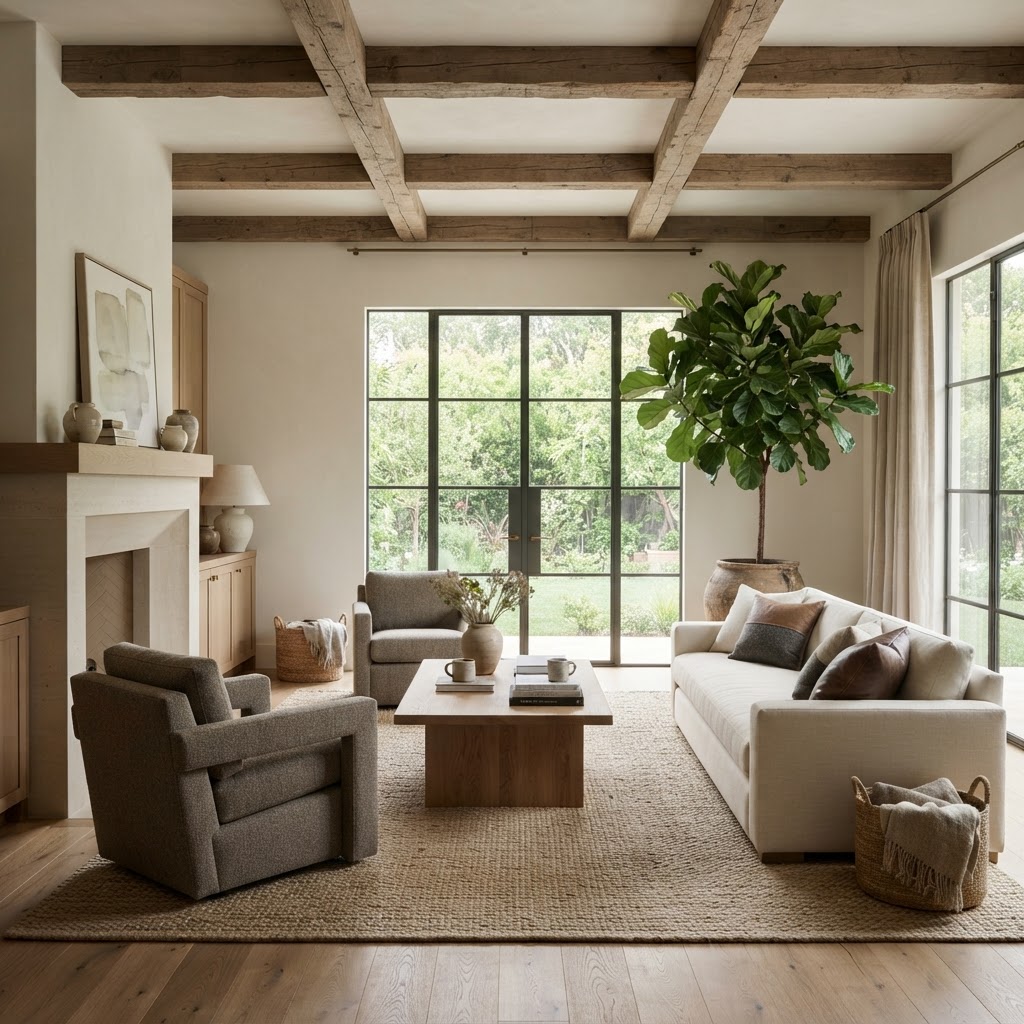
Rustic Contemporary Interior Design
Rustic & Farmhouse
Rustic Contemporary marries clean-lined modern architecture with the raw, honest character of organic materials to create a space that is both structurally refined and deeply grounded.
What Defines Rustic Contemporary Style?
This style emerges from a desire to reconcile contemporary precision with the soothing influence of the natural world. It prioritizes the inherent beauty of reclaimed wood and stone, stripping away unnecessary ornamentation to focus on form, tactile comfort, and spatial clarity. By softening sharp, modern silhouettes with earth-toned textiles and artisanal craft, the aesthetic creates a retreat that feels intentionally curated rather than cold. The intent is to provide a serene, composed environment where every element—from the grain of the timber to the weave of the linen—contributes to a sense of sophisticated, quiet seclusion.
Key Characteristics
Architecture
The space is defined by clean-lined, contemporary structural volumes that are softened by the commanding presence of heavy, reclaimed timber beams across the ceiling.
Materials
Designers lean heavily into raw, organic finishes like wide-plank oak flooring and honed natural stone to ground the interior in a tactile, earthy reality.
Furniture
Low-profile, structured furniture pieces eschew ornate detailing in favor of clean, contemporary silhouettes that prioritize both visual simplicity and enduring physical comfort.
Colors
A sophisticated monochromatic palette of warm grays, soft creams, and deep earth tones establishes a light, airy canvas punctuated by rich, grounding wood accents.
Textiles
Authenticity is achieved through the artful layering of natural performance fabrics, including soft wool, weathered leather, and linen, which add essential depth and warmth.
Lighting
Soft, ambient lighting is utilized to accentuate the room’s textural layers, avoiding harsh illumination in order to maintain a quiet, serene, and inviting evening atmosphere.
Decor
Minimalist abstract art and handcrafted stoneware pieces introduce a sense of human craft, while large-leaf greenery brings vital organic movement to the structured surroundings.
Rustic Contemporary Rooms
See how the defining elements of Rustic Contemporary come together in complete interiors.
Look Closer
The materials and details that give Rustic Contemporary its distinctive character.
Signature Pieces
Furniture, lighting and accents that instantly reinforce the Rustic Contemporary look.
See it in Motion
Experience how the space, light and defining details come together in motion.
Rustic Contemporary Color Palette
Rustic Contemporary vs. Similar Styles
Styles can overlap in materials, forms, colors, and architectural details. These comparisons examine the characteristics that distinguish Rustic Contemporary when those signals overlap.
Rustic Contemporary vs. Rustic Farmhouse
Shared DNA
Defining Difference
Rustic Farmhouse relies on heritage-inspired silhouettes and high-contrast metal accents, whereas Rustic Contemporary utilizes low-profile, minimalist furniture and strictly omits matte black hardware in favor of stone-focused, seamless architectural lines.
Tie-Breaker
If the space features matte black hardware or iron lighting, classify as Rustic Farmhouse; if the space is devoid of black metal and emphasizes low-profile, gallery-like minimalism, classify as Rustic Contemporary.
Rustic Contemporary vs. Hollywood Cottage
Shared DNA
Defining Difference
Hollywood Cottage prioritizes glamorous, cinematic, and high-contrast finishes to create a 'curated vintage' look, whereas Rustic Contemporary focuses on raw, low-profile, and matte-textured elements to evoke 'refined organic seclusion.'
Tie-Breaker
The presence of high-shine metallic or glossy finishes immediately classifies the room as Hollywood Cottage, regardless of the amount of rustic materials present.
Rustic Contemporary vs. Wabi-Sabi
Shared DNA
Defining Difference
Wabi-Sabi celebrates the aesthetic beauty of decay, asymmetry, and intentional imperfection, whereas Rustic Contemporary uses natural materials to soften and ground refined, precise, and contemporary architectural forms.
Tie-Breaker
If the room exhibits contemporary clean-lined furniture combined with thriving lush plants, classify as Rustic Contemporary; if the room exhibits primitive/asymmetrical furniture combined with dried flora, classify as Wabi-Sabi.
Rustic Contemporary vs. Santa Barbara
Shared DNA
Defining Difference
Santa Barbara focuses on a Mediterranean-inspired architectural shell with archways and black metal, whereas Rustic Contemporary focuses on a clean-lined modern architectural shell that emphasizes structural wood beams and explicitly avoids black metal accents.
Tie-Breaker
Prioritize the presence of black steel window frames to confirm Style A; if black metal is explicitly absent in favor of exposed timber structural elements, prioritize Style B.
Rustic Contemporary vs. Nordic Cabin
Shared DNA
Defining Difference
Nordic Cabin focuses on a cozy, winter-insulated retreat aesthetic using softer, fluffy textures and lighter wood tones, while Rustic Contemporary emphasizes sophisticated, structured refinement through heavier reclaimed timber beams, stone elements, and darker wood contrasts.
Tie-Breaker
Prioritize the presence of structural stone and heavy reclaimed timber as the definitive markers for Rustic Contemporary, as these elements are absent in the lighter, softer Nordic Cabin aesthetic.
Rustic Contemporary vs. Modern Cottage
Shared DNA
Defining Difference
Modern Cottage is rooted in traditional, smaller-scale architectural heritage that prioritizes cozy, bright simplicity, whereas Rustic Contemporary relies on bold, architectural-scale raw materials like heavy timber and stone to create a sense of refined, minimalist seclusion.
Tie-Breaker
Prioritize the architectural scale: heavy reclaimed timber beams and dark natural stone indicate Rustic Contemporary, while traditional ceiling framing and soft white wall finishes indicate Modern Cottage.
Rustic Contemporary vs. Modern Colonial
Shared DNA
Defining Difference
Modern Colonial uses traditional architecture and historical motifs as its base, whereas Rustic Contemporary uses modern architecture as a canvas for raw, organic, and weathered textures.
Tie-Breaker
Prioritize the architectural backdrop; if the wall treatments are historical (molding, wainscoting) choose Modern Colonial, but if the ceiling features heavy structural timber, choose Rustic Contemporary.
Rustic Contemporary vs. Modern Rustic Lodge
Shared DNA
Defining Difference
Modern Rustic Lodge is defined by an immersive, high-ceilinged alpine sanctuary aesthetic that leans into dramatic, rugged luxury, whereas Rustic Contemporary focuses on a lighter, airy, and strictly monochromatic residential composition.
Tie-Breaker
If the space features matte black metal or high-contrast shadows, classify as Modern Rustic Lodge; if the space avoids black hardware and features a bright, airy monochromatic base, classify as Rustic Contemporary.
Rustic Contemporary vs. Organic Contemporary
Shared DNA
Defining Difference
Rustic Contemporary relies on the architectural anchor of heavy structural wood beams to create a refined cabin-like foundation, whereas Organic Contemporary prioritizes soft, sculptural fluidity and biophilic shapes to create a seamless, fluid connection between nature and the interior.
Tie-Breaker
If both styles appear present, the presence of fixed structural timber beams dictates a classification of Rustic Contemporary, while the absence of beams combined with sculptural, curved furniture dictates Organic Contemporary.
Rustic Contemporary vs. Modern Rustic
Shared DNA
Defining Difference
Style A focuses on a sophisticated, serene, and refined aesthetic through lighter monochromatic layering, whereas Style B integrates industrial-inspired high-contrast elements like matte black steel to create a more rugged, grounded edge.
Tie-Breaker
If the space features matte black metal accents or frames, it must be classified as Modern Rustic (Style B); Style A is reserved for spaces that lack these industrial punctuations.
What Style Is Your Room?
Upload a room photo to discover its decor style, influences, defining characteristics, color palette, and more.
Analyze My Room